


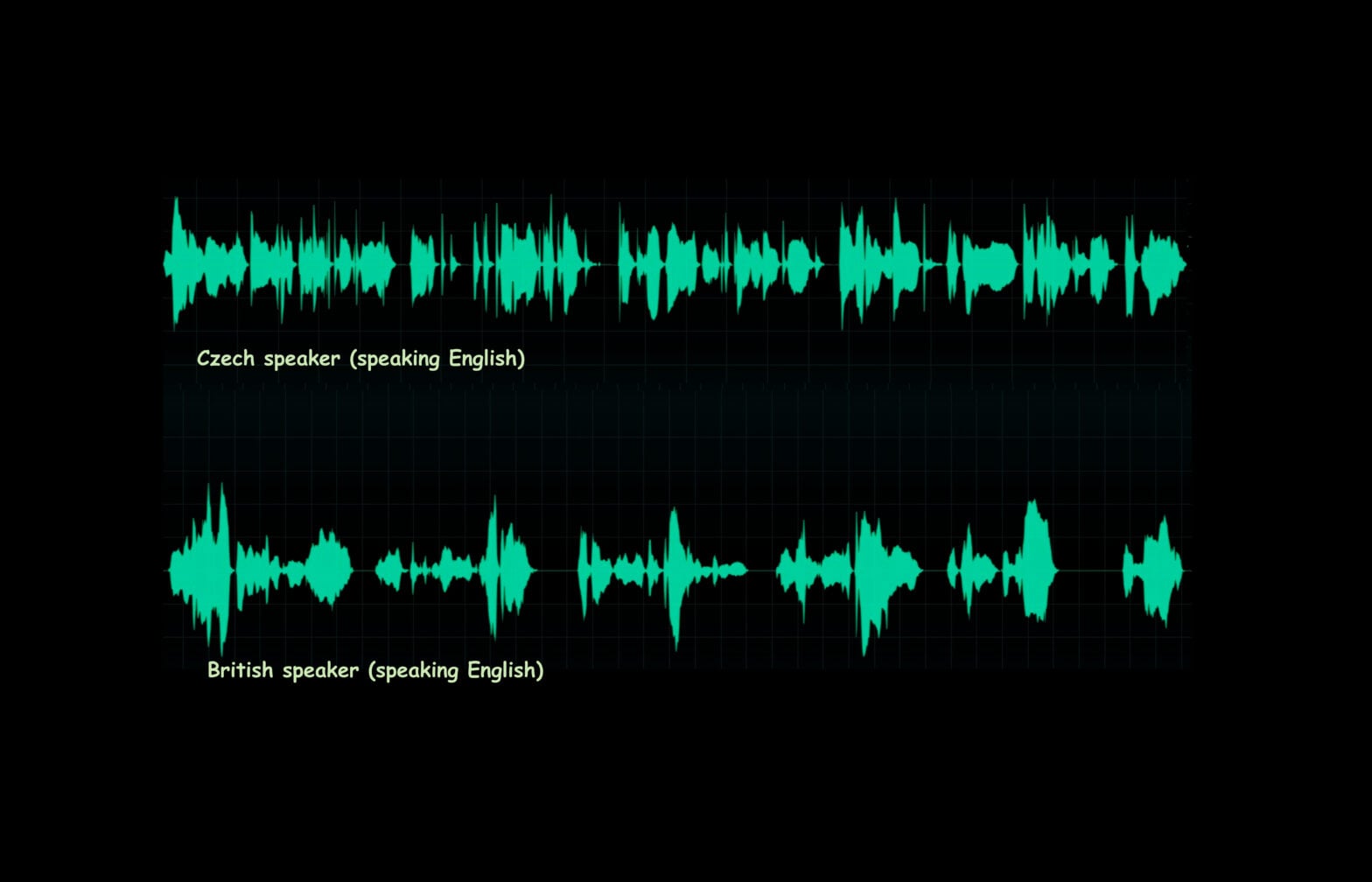
Listen to 3 different speakers:
// There was a suspicious-looking car / parked at the corner of the street / I didn’t pay much attention to it / though something was telling me / I’d seen it before. / But where? //
-
- Czech speaker with a Czech accent
-
- Czech speaker with an RP accent
-
- Native British English RP speaker
Perspectives on learning English Intonation from a Czech speaker
Speaking from the perspective of a Czech native speaker, learning English intonation is one of the most difficult aspects of an English accent to get right. Unlike learning a consonant, for example, where the requirements on producing the sound are somewhat clearly laid out, easily understandable and more tangible, learning intonation is harder to grasp and takes time to perfect, as it is so much more subtle.
First Step – Identifying Tone Units
First, I had to start with learning how to build a tone unit/phrase from “smaller blocks”; from the syllables in a word (concentrating on word stress), over weak forms and stressed syllables that create rhythm in a sentence, to understanding intonation and its nuances. In this way and after a lot of practice I began to break my speech down into the tone units/phrases required for native English intonation.
In comparison with English, Czech is a syllable-timed language, where every syllable has more or less equal length. If you listen to the above recording of a Czech speaker saying the example sentence, you can clearly hear that the same effort is put into producing each syllable, that there are no weak syllables, and vowels are not shortened.
Next Step – Identifying weak and strong syllables
This posed the first obstacle for me; the first thing I had to learn was how to alternate between weak and strong syllables within a word or a phrase, whilst learning to actually weaken those unstressed syllables in both multi-syllabic words such as ‘suspicious, across’ and in one-syllable function words such as ‘of, the, a’. It was with the help of David Brazil’s book Pronunciation for Advanced Learners of English and his theory of ONSETS and TONIC syllables that I started to realise the difference between strong and weak forms. This theory can be applied to words (UNimPORtant – where UN ‘un’ is the onset and ‘POR’ is the tonic syllable), short phrases and eventually sentences. Then, drilling exercises on stress-timing helped with the regular rhythm and producing the stressed syllables at phases of roughly same time intervals. Learning this and applying it then laid the foundations for getting intonation right.
Further Steps – Identifying the placement and type of tonic syllable -An idea is a phrase
In English as in Czech, an idea/phrase (ranging from 1-6 words) can be expressed in a tone unit with a prominent ‘tonic syllable’, the tonic syllable being towards the end of a phrase. Although the number of words can be the same in Czech and English phrases, due the fact that syllables are of equal length in Czech and that the first syllable of every word or prepositional phrase is stressed, phrases are longer (time-wise) and so the overall speech pattern is more level and less varied than in English.
As previously mentioned, Czechs tend to put the tonic syllable on the last content word towards the end of a tone unit, similarly as in English. However, because Czech has quite a flexible word order (a statement may have the same word order as a question), it is the intonation that decides what sentence type it is (Jdeš taky. (falling intonation) – Jdeš taky? (Rising intonation). The most common intonation patterns in Czech are the falling conclusive tones (sometimes using a rise-fall instead), the rising conclusive tone, and the non-conclusive tone. These tones have similar “uses”/implications as in English (the fall showing certainty, definiteness, the rise showing uncertainty, seeking for information, the fall-rise showing implication or an unfinished thought … we also use fall on wh-questions, etc.) As mentioned, Czech intonation is quite flat, so to an English speaker, a Czech person speaking can seem bored or disinterested. Therefore, it was quite a challenge to learn the higher pitch range of Modern RP.
Conclusion – Exploring further nuances in English Intonation
At the end of the day, I needed to put so much extra effort into learning the subtle differences of intonation patterns in English (“steps” and “bends” on tails, the high-fall tone with the high head or the high-fall tone with the rising head, etc.). More than with the tones themselves, I struggled with stress-timing and saying the tone on the right word/syllable.
From my personal experience, the best way to learn this is half passively and half actively. If a Czech learner is exposed to the English rhythm by only listening to native speakers, they start to use the rhythm, phrasing, and tones in their speech. The ear training helps them realise the sound/music of English that differs from the Czech one, which they then happen to subunconsciously use in their speech. This, however, needs to be backed up by theory and drilling exercises for the students to be able to actively use the different intonation patterns and nuances of English intonation.
In the end, the nearer one gets to perfection in intonation , the more subtle and difficult the nuances are to hear. The key to learning English Intonation is listen listen listen, practice practice practice!
by Veronika Drbolavová
Sources:
https://fonetika.ff.cuni.cz/en/czech-phonetics/
David Brazil – Discourse Intonation and Language Teaching (Applied Linguistics & Language Study S.)
Interesting reading:
David Brazil – The Communicative Value of Intonation in English
Wikipedia – https://en.wikipedia.org/wiki/Intonation_(linguistics)
Lucius Burgess: A demonstration of David Brazil’s Theory of Discourse Intonation
