


Under the Big Umbrella. What is Elocution?
Elocution simply means ‘to be eloquent’ and to be able to express oneself clearly and expressively with optimum communication for your situation. Many people have a very traditional perception of the term ‘elocution’ and that it involves an obligation to acquire a certain accent such as British RP (Received Pronunciation) or GenAm (General American), but it actually just means is to communicate clearly, expressively, eloquently and comfortably in your environment whilst fully engaging your listeners and getting your message across.
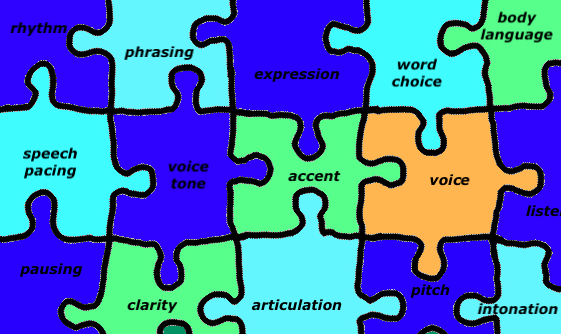
This means that the term ‘elocution’ sits under a wide umbrella of terminology which encompasses so many areas of speech, including voice projection, voice tone, tone, speech pacing, speech rhythm, intonation, expressiveness, accent clarity, articulation skills, concise phrasing, word choice, rhetoric and non-verbal communication skills such as gestures and body language. In fact, a staggering amount of communication is non-verbal!
What is your perception of elocution?
Many people are familiar with the classic line “The rain in Spain falls mainly in the plain” but is this really the essence of elocution? One’s accent is only part of it and one can communicate clearly in any accent provided all the elements of voice and speech are jigsawed together properly. Provided the listener focusses on the content of what you are saying rather than how you are saying it or trying to understand clarity, this is the essence of elocution: clear and expressive speech with good vocal projection; getting your message across clearly, assertively, expressively and concisely.
In order to communicate clearly, a good speech rhythm is as essential skill to develop. The stress-timed nature of the English language means that ‘message words‘ (the key content words) should be particularly emphasised and ‘function words‘ (smaller words like prepositions and articles etc) are relatively reduced in rhythm. Due to this, English has a very unequal rhythm. If one speaks in too much of a ‘syllable-timed’ rhythm in English (with equal syllable lengths) the clarity is reduced as the listener has more trouble distinguishing the message words from the function words, because they’re not standing out enough. It’s essential to highlight your key content words clearly in your speech rhythm.
Do you speak too quickly? What would happen if you slowed down? People need time to process what you are saying.
Speech pacing and tempo are crucial to good elocution skills and clarity. It’s important not to speak too quickly and to leave pauses. People need much more time to process what you are saying than you need to say it. Your listeners will be grateful to have time to take in the information you are giving them. Challenge yourself: What would happen if you slowed down? It is when one speaks too quickly without pauses that people can’t follow you and that can cause frustration, and in the end, lack of interest.
It’s not what you say, it’s the way that you say it
Intonation, the music of the voice, is particularly a key to clear, expressive speech. We use it to express assertiveness, surprise, agreement, doubt and more. It is important to speak with a clear and varied intonation to communicate expressively. In public speaking and presenting, a good and varied use of intonation can better engage your audience and can be the make or break of successful communication.
Here are some links to exercises to try some voice, intonation and articulation warm-ups for clear speech:
How do I breathe correctly for speaking? Voice warm-ups for all speech situations.
To check out some information on our Elocution lessons just visit:
This is an interesting article on the BBC website: https://www.bbc.co.uk/worklife/article/20210617-the-digital-body-language-cues-you-send-or-dont-send
Here are some books you may find helpful for speech training and improvement:
The First Minute by Chris Fenning
Unleash the Power of Storytelling by Rob Biesenbach
If you’d like to read a about the history of Elocution this page at Wikipedia is helpful.
